
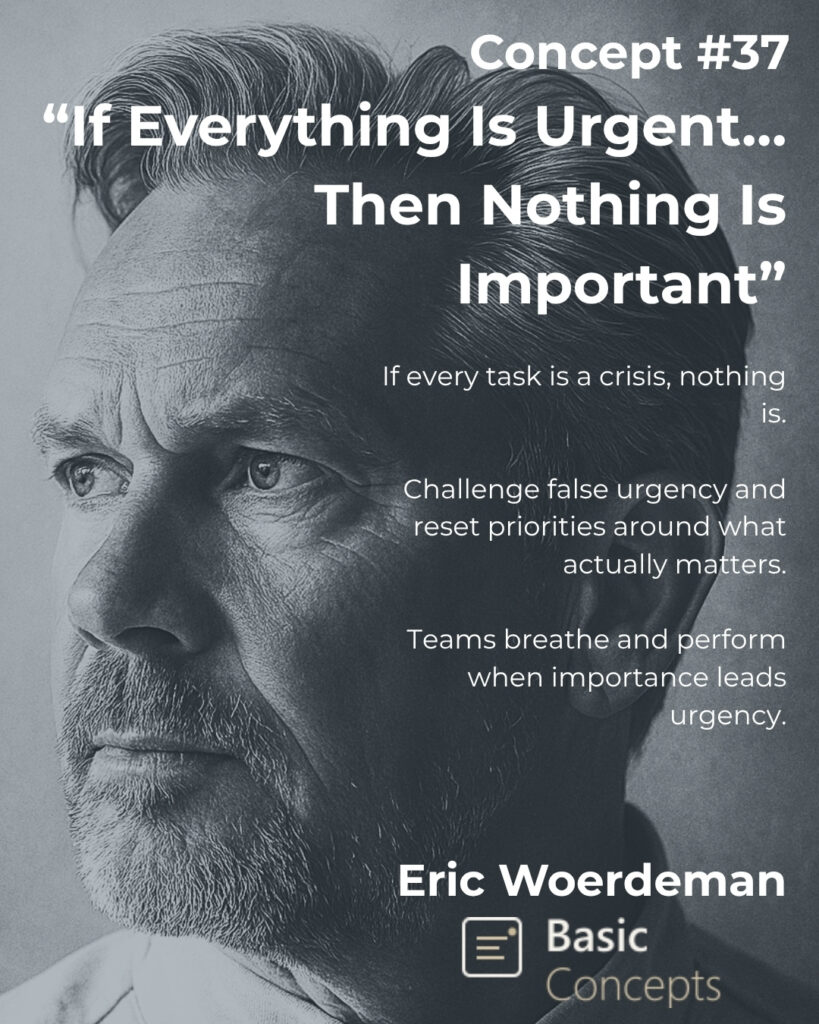
Basic Concept #37: If Everything Is Urgent…
… then nothing is important
Most teams have lived this at some point: every task is critical, every deadline is immediate, every meeting starts with pressure.
At first, urgency creates movement.
But when everything is treated as urgent, something breaks. People stop trusting priorities, deadlines lose meaning, and real problems become harder to recognize.
The signal disappears into the noise.
Urgency is not a strategy. It’s a state that spreads through teams when no one is creating clarity.
And the problem with constant urgency is simple: it doesn’t scale.
You can focus people around one real emergency. You cannot keep them effective while treating ten things as equally critical.
Over time, people adapt in unhealthy ways: they stop believing timelines, pad estimates, delay responses, or emotionally disconnect from the pressure altogether.
Meanwhile, the issues that truly matter no longer stand out.
This concept is about restoring perspective.
- Not every problem requires urgency.
- Not every delay is a crisis.
- And not every pressure signal deserves your nervous system.
Strategic people learn to separate importance from intensity. They understand that calm prioritisation creates more movement than permanent escalation ever will.
When everything is urgent, clarity disappears.
And without clarity, even good teams begin reacting instead of thinking.
Use what fits. Leave the rest.
You’ve seen the signal. The deeper work is learning how to apply it. The extended version of this concept includes:
- a longer reflection
- workplace scenarios
- guided questions
- and practical ways to recognise the pattern in your own environment.
A quieter, more structured way to work through the concept at your own pace.